Clean and Jerk Weightlifting: How Max Aita Coaches the Lift That Wins Meets
What actually breaks down in the clean and jerk — and how to fix it, phase by phase.
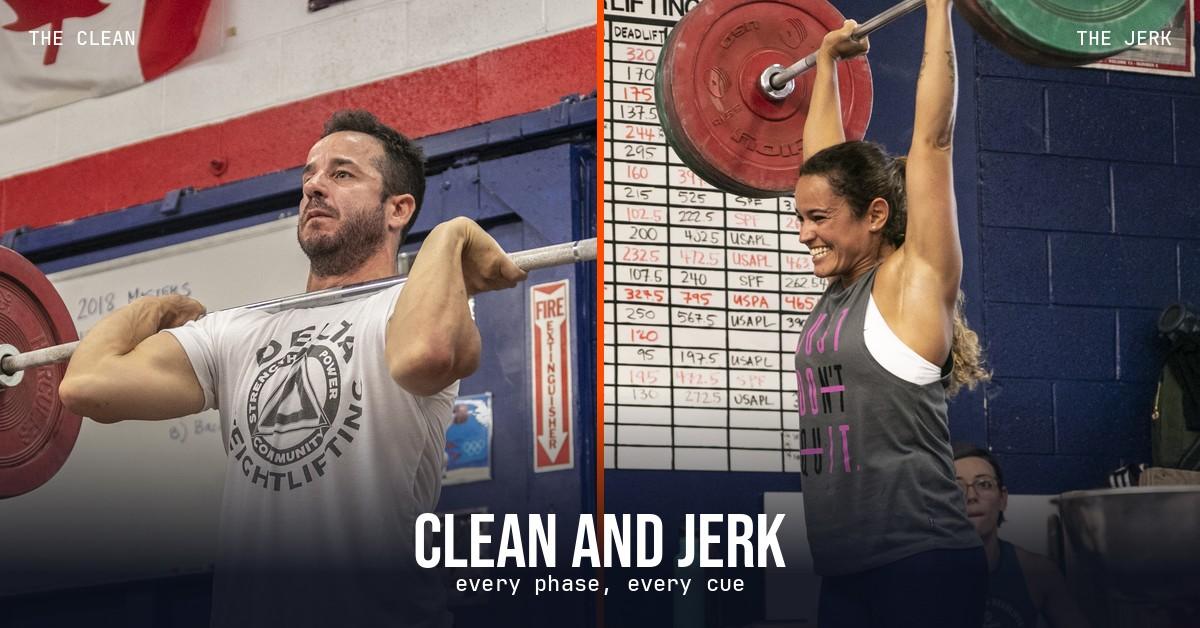
In this guide — 10 sections
The clean and jerk is the second lift in weightlifting competition — and the one that decides meets. While the snatch tests explosive precision, the clean and jerk tests everything: strength, technique, composure, and the ability to execute under maximum pressure. As a coach, I've watched athletes win meets on their final clean and jerk attempt and lose them the same way. What separates athletes who perform under pressure from those who don't isn't strength — it's technical mastery of two separate lifts that have to work together perfectly. This breakdown covers every phase of the clean and jerk the way I coach it, with equal attention to both the clean and the jerk.
By the time you take your first weightlifting clean and jerk attempt in a meet, the snatches are done and the scoreboard is set. Everything from here either holds your position or takes someone else's. That's the lens for this post: not how to do the lift, but how to make it under pressure. If you haven't already, start with our snatch coaching breakdown — the pulling principles carry over.
Part 1 of 2 — The Clean
The Clean Setup: Starting Right for Both Lifts
The clean setup follows the same checklist as the snatch, with one big difference: the grip. Hands go roughly a thumb's length outside the shoulders — much narrower than the snatch — which raises your hips slightly in the start and moves the bar's contact point from the hip crease to the upper thigh.
Everything else holds. Bar over the middle of the foot, close to the shins. Shoulders above or slightly in front of the bar. Hips above the knees, back set, arms long, lats keeping the bar close.
What most athletes miss: the setup isn't just setting up the clean. The grip you take on the floor is usually the grip you jerk with, and the bar you're about to pull has to land somewhere you can drive it from. Choices made before the bar moves echo through both lifts.
The Front Rack Setup — Thinking About the Jerk Before the Bar Moves
Before a meet attempt, I'm checking one thing most coaches don't: is this grip a jerk grip? If an athlete cleans narrow and has to shuffle their hands out before the jerk, that's an adjustment under a heavy bar with the clock running. I'd rather set the grip a finger or two wider on the floor — wide enough to jerk from directly. The fewer things to fix between the two lifts, the more you have left for the jerk.
The Clean Pull & Second Pull
The pull works exactly like the snatch pull: it's a push, not a pull. Legs press the floor away, shoulders and hips rise together, knees move back out of the way, bar drifts back toward you. With the narrower grip, contact happens at the upper thigh instead of the hip crease. And because clean weights are heavier, patience off the floor matters even more — the heavier the bar, the more a rushed first pull costs.
The finish is the same vertical idea: hips drive up through the bar, contact is a brush, the arms stay long until the legs are done, and then you pull yourself down and turn the elbows around the bar into the rack.
The CrossFit Power Clean Problem
A lot of athletes come to me from CrossFit, and they almost all carry the same habits: they pull the bar with the arms early, catch everything high, and treat the clean like a touch-and-go rep instead of a single maximal lift. It makes sense — in a workout, cycling the bar fast is the goal. In a meet, it's how you miss.
The correction is the same every time. Every clean gets ridden into the full front squat, even light ones, until catching high stops being the default. Heavy clean pulls teach the legs to finish the lift instead of the arms. And we slow the first pull down — "slow to the knee" — because the touch-and-go rhythm trains the opposite.
Want feedback on your own clean and jerk? Upload a lift video and get coached on it →
The Front Rack & Squat Recovery: Setting Up the Jerk
The front rack is where more cleans die than anywhere else. A correct rack means the bar is sitting on the shoulders, elbows up in front of the bar, fingers underneath — the shoulders carry the weight, not the wrists and not the arms.
What I see instead is the death grip: athletes holding the bar in their hands with the elbows low, trying to muscle the catch. A death-grip rack collapses forward under a heavy clean, and even when it survives, it wrecks the jerk — you can't drive a bar that's hanging off your wrists.
I coach the catch as a meeting, not a crash. The elbows whip around the bar as you sit, the bar lands on the shoulders the moment you arrive under it, and the trunk is already braced. If the bar is crashing on you, the turnover timing is off — we fix that with cleans from the power position before adding a single kilo.
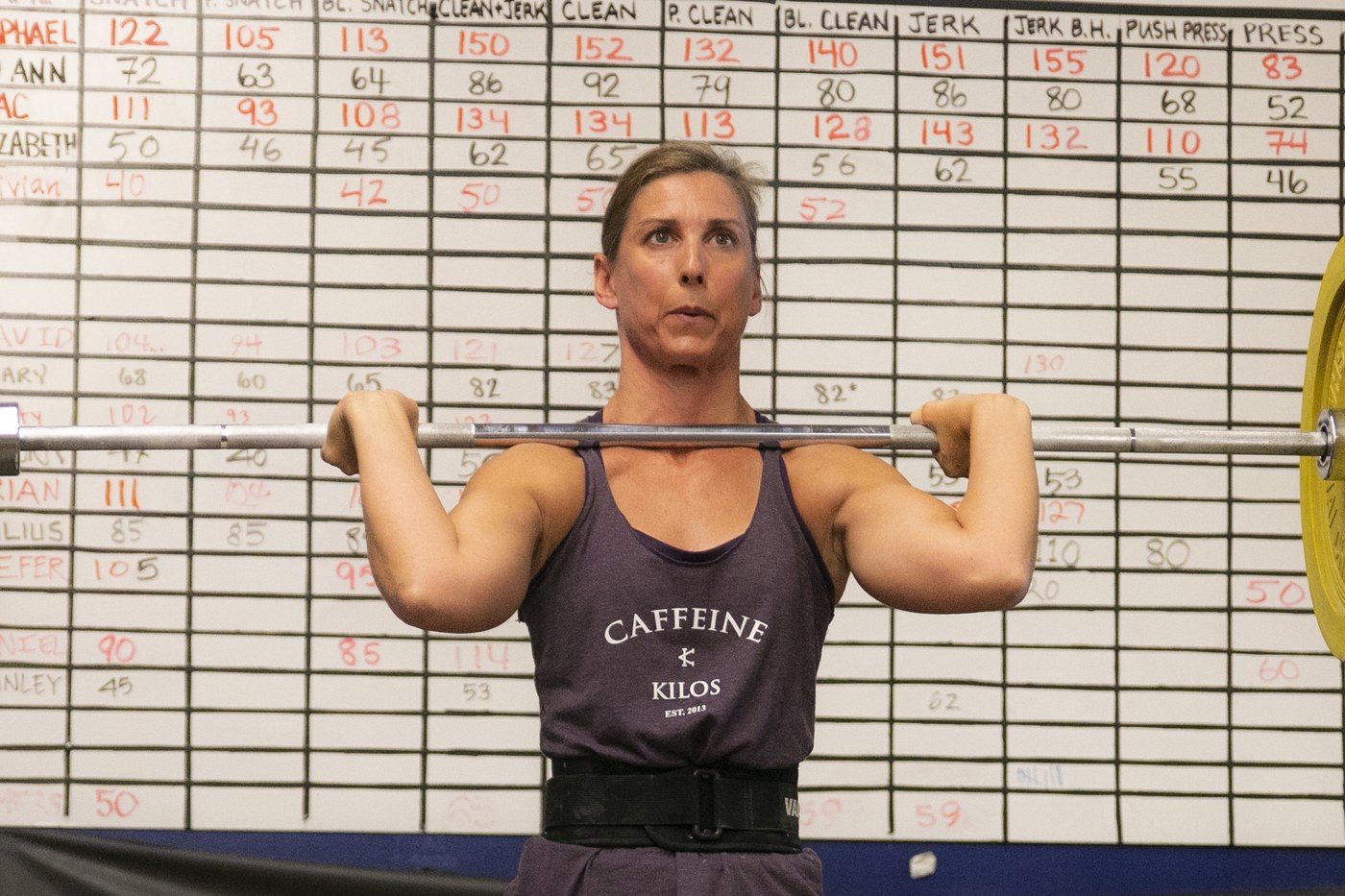
The front rack: bar on the shoulders, elbows up, weight carried by the shoulders — not the wrists.
The Recovery Sets Up the Jerk
Nobody misses a jerk in the bottom of the clean, but plenty of jerks are lost there. Every second spent grinding out of the squat is energy the jerk doesn't get. I coach athletes to ride the bounce — meet the bottom, stay tight, and come up in one motion instead of sitting in the hole deciding whether to stand. Elbows stay up the whole way; the moment they drop, the bar slides, the breath goes, and you're rescuing the clean instead of preparing the jerk. Stand fast, stand once.
Part 2 of 2 — The Jerk — The Lift That Wins Meets
Between the Clean and the Jerk: The Seconds Nobody Writes About
Watch the best lifters in the world and you'll notice the same thing: after they stand up from the clean, nothing happens for a few seconds. Those seconds are coached.
Here's what I have athletes do, in order. Settle the bar: one adjustment maximum — slide the hands to the jerk grip if needed, reset the bar on the shoulders, done. Fidgeting with the bar three or four times burns time and telegraphs doubt. Then the breath: one big breath into the belly, brace, hold it for the dip and drive. Then the eyes: pick a spot at eye level and keep them there. Feet set under the hips, weight over the whole foot.
That's the whole ritual, and it's rehearsed on every clean and jerk in training, including warm-ups, so that on meet day there's no decision to make. The athletes who hold composure on a third attempt aren't calmer people — they've just done the next five seconds a thousand times.
The Dip & Drive: Where the Jerk Is Won or Lost
If you miss a jerk, the miss almost certainly started in the dip. It's a small movement — a bend of the knees of maybe ten centimeters — and everything about the lift depends on it being exact.
The dip is straight down. Torso vertical, like an elevator. Weight over the whole foot, heels connected to the floor. Depth shallow — deeper doesn't mean more power, it means a slower rebound and a bar drifting off the shoulders. And the change of direction at the bottom has to be firm but not frantic: too slow and you lose the stretch reflex, too fast and the bar separates from your shoulders and crashes into you at the bottom.
Then the drive: legs extend as hard as possible, the bar leaves the shoulders, and only after the legs finish do the arms push the body down into the split. The arms don't lift the bar in the jerk. The legs throw it; the arms fix it.
On meet day, the dip is the first thing I watch in the warm-up room. Clean at 80%, the athlete is fine. Hips drifting forward in warm-ups, we fix it there — it will not fix itself under a PR.
What I Cue in the Dip
The actual words: "Straight down, straight up." "Big chest" — for the athlete who tips forward. "Heels" — one word, for the athlete whose weight sneaks onto the toes. "Smooth down, violent up" — for the athlete who rushes the dip. And right before a big attempt, usually just: "Legs." It means everything we've trained — drive with the legs, don't press with the arms — compressed into the one word an athlete can actually hold onto under pressure.
The 3 Most Common Dip Errors
Too deep. The athlete dips toward a quarter squat chasing power. What they get is a slow rebound and a bar that's already drifted off the shoulders. Fix: pause dips at the correct depth until the athlete can feel where the bottom is, then dips with a light bar watching themselves on video.
Too fast. The athlete drops out from under the bar, the bar separates from the shoulders, and they collide at the bottom of the dip. All the drive goes into absorbing the crash. Fix: "smooth down, violent up," and tempo dips — two seconds down, explode up.
Forward lean. The hips slide forward or the chest tips at the bottom, and the drive angles the bar out front. This is the most expensive one because it feels almost right. Fix: pause dips in profile on video, checking that the bar is over the whole foot at the bottom, plus jerks from behind the neck to groove a purely vertical drive.
The Split & Catch: Competition Position
The split exists because it's the fastest way under the bar with a base you can trust. Front foot steps out and lands flat, shin vertical. Back foot slides further than feels natural, heel up, toes slightly in, back knee soft. Hips stay under the shoulders — drift forward and the whole structure tips. The bar locks out over the back of the head, arms finished the instant the feet land.
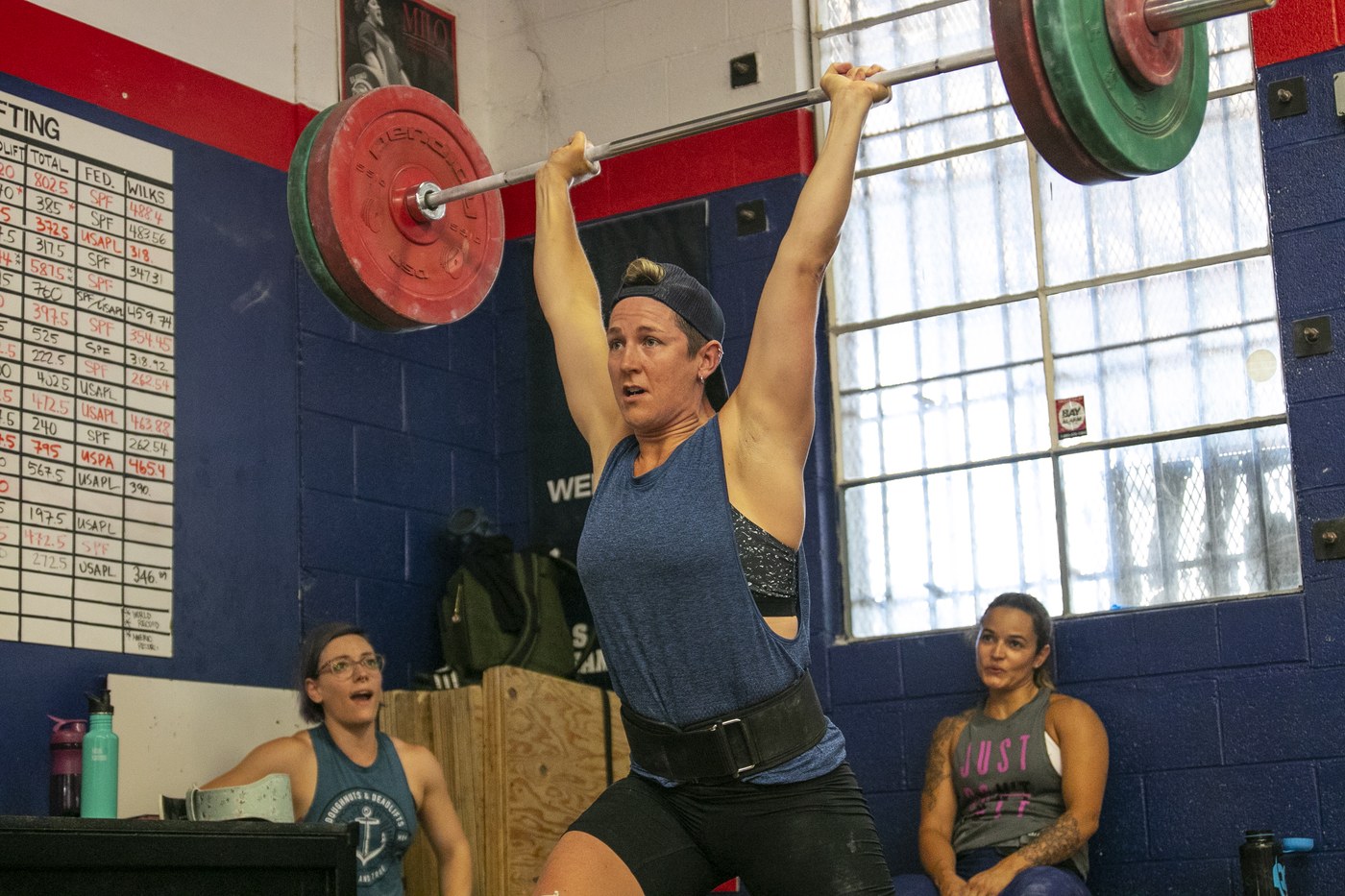
Competition split position: bar locked out overhead, front foot forward, back knee soft, hips under the shoulders.
The order of the recovery is not optional: front foot steps back first, then the back foot comes forward, bar overhead and eyes forward the entire time. Recover back-foot-first and the bar drifts forward with you — that's how made jerks turn into missed lifts in the last second.
In training, I hold athletes to the competition standard on every rep: feet land, elbows locked, bar still, then recover in order and wait. There is no version of the jerk where "good enough in the gym" transfers to three white lights.
What Three White Lights Require
The judges are ruling on a few specific things: elbows locked when the bar arrives and no re-bend, no visible press-out, feet returning to line, and the bar under control until the down signal. Here's how I coach athletes to handle that without lifting scared: you don't think about judges mid-lift — you train standards so strict that the judging takes care of itself. Every training rep ends with a deliberate one-second hold and a clean recovery. If your normal is stricter than the rulebook, meet day is just another rep.
The 4 Most Common Jerk Errors — And How I Fix Them
In weightlifting, jerk and clean errors get lumped together too often — but these are jerk errors, not clean errors, the misses that happen after the athlete has already stood up with the bar. Fixing them in isolation only goes so far; how the jerk fits into a competition-ready programme covers how this work gets scheduled alongside everything else.
Forward Dip
The hips slide forward on the way down, so the drive launches the bar out front. It happens because a vertical dip requires more ankle and thoracic position than most athletes have ever been asked for. Fix: pause dips checked on video, and the cue "dip where you'll drive."
Soft Lockout / Press-Out
The bar arrives on bent elbows and gets finished with the arms. In the gym it's a made lift; on the platform it's three red lights. The cause is driving with the arms before the legs finish, or a slow punch into the split. Fix: drop jerks and jerk balances with one standard — elbows locked before the feet finish landing.
Short Split
The back foot barely leaves its spot, the base is small, and the athlete is standing almost upright under the bar with nowhere to absorb it. Athletes do it because a real split feels like a long way to fall. Fix: mark the foot positions on the platform with tape and hit the marks on every warm-up rep until the full split is the automatic one.
Bar Drifting Behind During Drive
The athlete overcorrects the forward miss and drives the bar behind the base, chasing it backward or dumping it. Usually it comes from throwing the head back through the drive instead of moving it out of the way. Fix: eyes on a fixed spot straight ahead, chin back — not up — and jerks with a pause at the split to prove the bar can live over the back of the head without traveling behind it.
Coaching cues, not just a program.
Reading about the jerk and having it coached on competition day are different things. Team Aita gives you Max Aita's coaching cues, video lift review, and a programme that builds competition-ready technique into every session.
Frequently Asked Questions
What is the clean and jerk in weightlifting?
The clean and jerk is the second of the two competition lifts in the sport of weightlifting. It's two separate lifts performed back to back and scored as one: the clean brings the bar from the floor to the shoulders, and the jerk drives it from the shoulders to locked out overhead. Your best snatch plus your best clean and jerk make up your total.
Why is the clean and jerk harder than the snatch?
It's not harder — it's a different problem. The loads are heavier, you have to solve two technical challenges back to back instead of one, and in competition it comes last, when the meet is on the line and fatigue is real. The snatch punishes imprecision. The clean and jerk punishes everything.
How do I improve my jerk without improving my clean?
Separate the jerk from the clean so the clean stops taxing it. With athletes who jerk less than they clean, I program jerks from the rack or blocks so they can handle heavy weights fresh, add jerk dips and jerk drives to build the pattern, and have them jerk twice on every clean and jerk warm-up set. Most jerk problems are a volume problem — the jerk simply gets practiced less.
What is a good clean and jerk for a competitive weightlifter?
It depends entirely on bodyweight, age, and level, which is why the honest answer is a range. A clean and jerk at bodyweight is a solid early milestone for most adult lifters; roughly one and a half times bodyweight puts you in genuinely competitive territory at local and regional meets; national-level lifters are typically well beyond that. Chase qualifying totals for the meets you actually want to enter, not someone else's numbers.
The clean and jerk wins meets.
But only when the technique holds under competition pressure. Max Aita's programme builds that pressure-tested technique into every training session.
Start Your Weightlifting Journey
Join the team and start coaching with clarity — use data, readiness, and quality work to drive better sessions.