Women’s Olympic Weightlifting: Weight Classes, Records, and How It Works
A coach’s guide to how the sport actually works.
6 Sections
Olympic weightlifting for women includes several bodyweight categories, with each athlete competing in two lifts, the snatch and the clean & jerk, combined into a total to determine the winner. Women's weightlifting has been part of the Olympic Games since Sydney 2000. Below, I'll explain the current weight classes, world records, and top athletes, along with what these numbers mean from a coaching perspective.
When Olivia Reeves won gold at the 2024 Paris Olympics, she became the first American woman to win Olympic weightlifting gold since Tara Nott in 2000. It was a major moment for American weightlifting, especially considering how competitive women's weightlifting has become internationally.
I've coached weightlifting for more than 20 years, working with everyone from beginners to international competitors. In this guide, I'll explain how the sport works, how weight classes are organized, and what makes the world's best women so good.
How Women's Olympic Weightlifting Works
Olympic weightlifting for women uses the same two lifts as the men's sport: the snatch and the clean & jerk.
Athletes get three attempts at each lift. Their best successful snatch and clean & jerk are added together to produce a total, and the athlete with the highest total wins.
The scoring is straightforward. The lifts themselves take years to master.
The Snatch
The snatch is the first lift contested in a weightlifting competition.
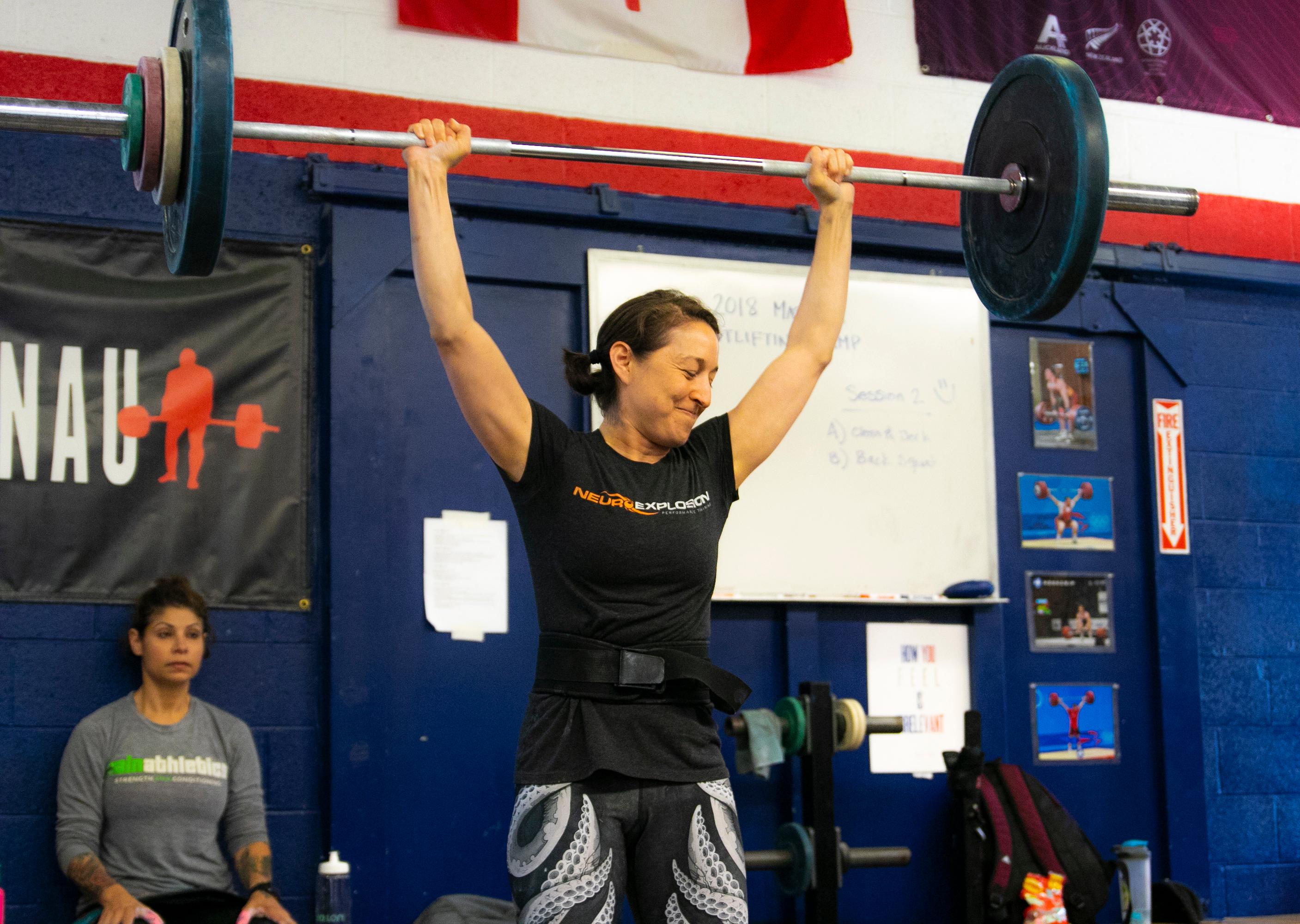
The athlete takes the barbell from the floor to overhead in one continuous movement. Most lifters receive the bar in a deep overhead squat before standing up to complete the lift.
The athlete must accelerate the bar, move under it, and receive it in a stable overhead position. All of this happens in a fraction of a second.
One of the most important skills in the snatch is moving efficiently under the bar. The athlete needs enough pulling power to elevate the weight and enough speed and coordination to move into the receiving position.
As weights get heavier, small technical errors become much harder to recover from.
The Clean & Jerk
The clean & jerk consists of two movements performed together.
First, the athlete pulls the bar from the floor to her shoulders. This is the clean. Most lifters receive the bar in a front squat and stand up.
Next comes the jerk. The athlete drives the bar overhead using her legs and arms, typically receiving it in a split position before recovering to stand.
Athletes can generally lift more weight in the clean & jerk than in the snatch because the movements allow them to use their strength differently.
The clean and jerk also require different physical qualities. An athlete might have a very strong clean but struggle with the jerk, especially when the weight gets heavy enough to challenge her overhead stability. That is why a strong clean doesn't guarantee a strong jerk.
How the Total Works
Suppose an athlete makes the following attempts:
| Lift | Attempt 1 | Attempt 2 | Attempt 3 |
|---|---|---|---|
| Snatch | 95 kg ✓ | 100 kg ✓ | 103 kg ✗ |
| Clean & jerk | 120 kg ✓ | 125 kg ✓ | 128 kg ✗ |
Her best snatch is 100 kg, and her best clean & jerk is 125 kg. Her competition total is 225 kg.
At the Olympics, medals are awarded based on the total. At the World Championships, medals are also awarded separately for the snatch and clean & jerk.
Basic Competition Rules
Each athlete receives three attempts in the snatch and three attempts in the clean & jerk.
The competition begins with the lightest requested weight. As attempts are completed, the weight on the bar increases throughout the session.
An athlete who misses all three attempts in either lift will not receive a total. This is commonly called bombing out.
If two athletes finish with the same total, the athlete who achieved that total first wins the tie.
Coaches also have to manage attempts carefully. Opening weights, jumps between attempts, and changes based on the competition can all affect the final result. At the international level, a one-kilogram change can move an athlete several places in the standings.
A Brief History of Women's Olympic Weightlifting
Women competed internationally for years before the Olympics added weightlifting to the women's program.
The first Women's World Weightlifting Championships were held in 1987. The first women's weightlifting Olympics was Sydney 2000, where the sport made its debut on the Olympic program.
American Tara Nott won gold in the 48 kg category at Sydney, becoming the first American woman to win Olympic weightlifting gold.
Women's weightlifting has developed considerably since then. Participation has increased, international competition has become deeper, and the performances required to win medals have improved.
The sport has also gone through several changes to its bodyweight categories. These changes make it difficult to compare results across eras. When the IWF introduces a new bodyweight category, it establishes new records or record standards for that class. A record set in a previous category may remain historically significant without appearing in the current record tables.
The competition format has remained consistent. Athletes continue to compete in the snatch and clean & jerk, with their combined total determining their overall placing.
Women's Olympic Weightlifting Weight Classes
Women currently compete in eight senior bodyweight categories at International Weightlifting Federation (IWF) events. The latest categories took effect on August 1, 2026.
Current Women's Weight Classes
| Weight Class | Maximum Bodyweight |
|---|---|
| 49 kg | 49 kg (108 lb) |
| 53 kg | 53 kg (117 lb) |
| 57 kg | 57 kg (126 lb) |
| 61 kg | 61 kg (134 lb) |
| 69 kg | 69 kg (152 lb) |
| 77 kg | 77 kg (170 lb) |
| 86 kg | 86 kg (190 lb) |
| +86 kg | Over 86 kg |
An athlete's body weight determines their category at the official weigh-in. For example, an athlete weighing 60.5 kg would compete in the 61 kg category. An athlete weighing 61.2 kg would have to compete in the 69 kg category or reduce her weight enough to make the 61 kg limit.
Women's Olympic Weight Classes for Los Angeles 2028
The Olympics include fewer weight classes than the full IWF program. For Los Angeles 2028, women will compete in six categories.
| Olympic Category | Weight Limit |
|---|---|
| 53 kg | Up to 53 kg |
| 61 kg | Up to 61 kg |
| 69 kg | Up to 69 kg |
| 77 kg | Up to 77 kg |
| 86 kg | Up to 86 kg |
| +86 kg | Over 86 kg |
The difference between Olympic and non-Olympic categories creates some difficult decisions for athletes and coaches. For example, an athlete competing at 57 kg internationally would have to move to either 53 kg or 61 kg to pursue Olympic qualification. Both options affect training and performance.
Moving down may require reducing body weight and potentially losing muscle mass. Moving up lets the athlete gain weight, but that additional weight must translate into enough strength to stay competitive.
I've coached athletes through these decisions, and the process usually takes considerable planning. We look at current performance, body composition, training history, and how much strength the athlete can realistically gain or maintain at different body weights. The goal is to find the category where the athlete has the best chance of producing a competitive total. At the Olympic level, an athlete may spend several years preparing for a particular category.
Women's Olympic Weightlifting Records
Women's weightlifting records are organized by bodyweight category and by lift. The IWF recognizes records in the snatch, clean & jerk, and total.
Because the current weight classes were introduced in August 2026, some categories have recently established records. Others have world standards that athletes must exceed to establish a record.
Women's World Records (October 2026)
| Weight Class | Snatch | Clean & Jerk | Total |
|---|---|---|---|
| 49 kg | 94 kg | 121 kg | 215 kg |
| 53 kg | 99 kg* | 126 kg* | 223 kg* |
| 57 kg | 104 kg | 134 kg | 238 kg |
| 61 kg | 112 kg | 139 kg | 251 kg |
| 69 kg | 121 kg | 152 kg | 273 kg |
| 77 kg | 123 kg | 155 kg | 278 kg |
| 86 kg | 129 kg* | 162 kg* | 289 kg* |
| +86 kg | 145 kg | 181 kg* | 325 kg* |
An asterisk indicates an IWF world standard rather than a record achieved in competition. Source: IWF senior women's world record listings.
One of the easiest ways to appreciate these numbers is to compare them with the athlete's bodyweight.
Coach's eyeIn the 49 kg category, the record snatch is 94 kg. That's approximately 192% of the category's bodyweight limit. The clean & jerk record is 121 kg, or about 247% of the bodyweight limit. These are exceptional levels of relative strength.
The physical demands also increase as athletes approach their maximum ability. The closer an athlete gets to her limit, the more important precise timing, balance, and consistent movement become. A small error in the pull, receiving position, or recovery can cause a missed lift.
At this level, athletes also have to reproduce their best performances under competition conditions. They may have only a few minutes between attempts, and changes in attempt selection can force them to prepare for weights they weren't originally expecting.
This combination of strength, technical ability, and competition experience develops over years of training.
Want to learn the fundamentals of the snatch and clean & jerk? Our Beginner Weightlifting Program covers the basic positions and movements used to develop weightlifters. See the Beginner Program →
Notable Women's Olympic Weightlifting Athletes
Several women are worth watching if you want to understand what elite weightlifting looks like. Each of these athletes has succeeded at the Olympic level, and their performances offer useful examples of the sport's physical and technical demands.
Hou Zhihui (China)
49 kg · Gold, Tokyo and Paris
Hou Zhihui won Olympic gold in the 49 kg category at both Tokyo and Paris. She's an excellent technical lifter, particularly in the snatch. Her pulling mechanics and ability to move under the bar allow her to lift very heavy weights relative to her bodyweight.
Coach's eyeAt Paris 2024, Hou made a 117 kg clean & jerk on her final attempt to win the gold medal. That lift shows the pressure athletes face during international competition. She needed to make the weight to win, and she did.
Olivia Reeves (United States)
71 kg · Gold, Paris 2024
Olivia Reeves won the 71 kg category at Paris 2024, becoming the first American woman to win Olympic weightlifting gold in 24 years.
Reeves is particularly strong through the legs and has excellent control of her receiving positions. Her lifting reflects the physical development and technical practice required to handle those kinds of weights.
Reeves went on to set world records in the 77 kg category, including a 278 kg total at the 2025 World Championships.
Coach's eyeWhen I watch her lift, one thing that stands out is how consistently she maintains her positions under heavy loads. She's one of the strongest examples of how good strength development and technical consistency can work together.
Solfrid Koanda (Norway)
81 kg · Gold, Paris 2024
Solfrid Koanda won Olympic gold in the 81 kg category at the 2024 Paris Olympics. Koanda is exceptionally strong, and that strength shows most clearly in her clean & jerk.
Her performances show how important leg strength and pulling strength are in Olympic weightlifting. She also has the technical ability to apply that strength effectively.
Coach's eyeFor athletes with a strong technical foundation, building more strength is often one of the most effective ways to increase their total. Koanda provides a good example of that relationship.
Li Wenwen (China)
Superheavyweight · Gold, Tokyo and Paris
Li Wenwen won Olympic gold in the superheavyweight category at both Tokyo and Paris. At Paris 2024, she snatched 136 kg and clean & jerked 173 kg for a 309 kg total. Those are enormous weights, especially given the speed required for both lifts.
Heavier athletes generally have greater absolute strength, and superheavyweight competitions feature the largest weights in women's weightlifting. Li combines that strength with the mobility, coordination, and technical ability to complete the lifts consistently.
Coach's eyeShe's a great athlete to watch if you want to see Olympic weightlifting technique under extremely heavy loads.
The US Women's Olympic Weightlifting Team
The United States sent three women to the 2024 Paris Olympics.
| Athlete | Category | Paris 2024 Result |
|---|---|---|
| Jourdan Delacruz | 49 kg | 5th |
| Olivia Reeves | 71 kg | Gold |
| Mary Theisen-Lappen | +81 kg | 5th |
Reeves had the standout result, winning gold, while Delacruz and Theisen-Lappen both finished fifth.
Mary Theisen-Lappen is an interesting example of an athlete who entered weightlifting relatively late. Many international athletes begin training young, but some successful weightlifters enter the sport as adults. Athletes from strength sports can sometimes progress quickly because they already have a strong foundation in strength and general athleticism. They still need to develop weightlifting technique, regardless of previous experience.
With the 2028 Olympics in Los Angeles, the United States will have another chance to compete at home. The Olympic qualification and selection process will determine the final roster leading up to the Games.
Frequently Asked Questions
When is women's weightlifting at the Olympics?
Women's weightlifting takes place during the Summer Olympic Games, with each bodyweight category competing in its own session. At Los Angeles 2028, weightlifting is scheduled for July 25 to 29.
Who is the current Olympic women's weightlifting gold medalist?
Each women's bodyweight category has its own Olympic gold medalist. The gold medalists from Paris 2024 were Hou Zhihui of China at 49 kg, Luo Shifang of China at 59 kg, Olivia Reeves of the United States at 71 kg, Solfrid Koanda of Norway at 81 kg, and Li Wenwen of China at +81 kg. These were the categories contested in Paris. The categories will change for Los Angeles 2028.
What is the bar weight in women's Olympic weightlifting?
The women's competition barbell weighs 15 kg (about 33 pounds). It has a 25 mm grip diameter and is shorter than the men's 20 kg barbell, which has a 28 mm grip diameter. The smaller grip diameter makes the barbell easier for athletes with smaller hands to hold.
How many weight classes are there in women's Olympic weightlifting?
The IWF currently recognizes eight senior women's weight classes: 49, 53, 57, 61, 69, 77, 86, and +86 kg. At the Los Angeles 2028 Olympics, six of those categories will be contested: 53, 61, 69, 77, 86, and +86 kg.
How strong are Olympic women weightlifters?
Olympic female weightlifters have exceptional strength, especially relative to their bodyweight. In the lighter categories, top athletes can snatch nearly twice their bodyweight and clean & jerk well over twice their bodyweight. Their training usually includes squats, pulls, pressing exercises, and extensive practice of the competition lifts. They develop strength alongside the speed, mobility, and coordination required to use that strength in the snatch and clean & jerk.
How can I get started in Olympic weightlifting myself?
Start by learning the basic positions of the snatch and clean & jerk with light weights. I usually recommend that beginners spend time working on their receiving positions, overhead stability, and basic pulling mechanics. Squats, pulls, and overhead exercises should also be part of their training. As those skills improve, you can gradually increase the weight while continuing to practice the full lifts. A good coach or a structured beginner program helps keep training organized and gives you a clear path to progress. If you want a sense of the longer road, we cover what it actually takes to become an Olympic weightlifter. Our Beginner Weightlifting Program teaches those skills and helps new lifters build a foundation for long-term progress.
Start Learning Olympic Weightlifting
You can start training the snatch and clean & jerk at almost any strength or experience level. This is how I've approached coaching weightlifters throughout my career, and it's the foundation of our programming at Team Aita.
Start Free Trial →Start Your Weightlifting Journey
Join the team and start coaching with clarity — use data, readiness, and quality work to drive better sessions.